A Crowded Field, and a Narrow Entry Point
A four year old near Highlands Elementary or Citrus Elementary looking for beginner karate classes rarely fits well into a class built around students who have already trained for years, and a Pre-K program solves that specific mismatch rather than papering over it. Sensei Dave Roth has personally taught every level at this dojo since 1994, holding a 7th-degree Shorin-Ryu black belt along with additional rank in jujitsu, Kobudo, and Arnis, so a beginner and an advanced student answer to the same instructor rather than being split off to an assistant.
Families near Glendale Elementary or Osceola Magnet School are often within a few minutes of 1140 19th Street, closer in practice than the drive to some grocery stores or medical offices already part of a normal week. Distance was never the obstacle here. Finding a program willing to start a child from zero, without assuming prior exposure to karate or jujitsu, has been the harder piece to solve.
What a New Student Gets Here That Is Harder to Find Nearby:

A Pre-K class built entirely around ages three to five, not a general kids class that happens to accept younger children.
-
Youth martial arts paced for someone who has never trained, so catching up to classmates does not take months.
-
A family option where a parent trains in the same room, not a separate adult class scheduled at a different hour.
-
Camp coverage during Indian River County school breaks, useful for a family without a built-in plan for those weeks.
Six Disciplines, One Instructor
Everything taught here falls under programs built around age and experience level, starting with the youngest group first:
-
Pre-K Karate, Ages 3 to 5: Pre-K karate relies on games, not drills, since a child this age learns coordination and following directions through play rather than repetition alone.
-
Youth Martial Arts, Ages 6 to 12: Youth martial arts blends striking with grappling, and spends real time on de-escalation, not just technique drills.
-
Family Martial Arts: Family martial arts has a parent and child working the same drill sequence, in the same session, rather than one supervising from a bench.
-
Karate and Jujitsu: Okinawan Shorin-Ryu striking taught alongside Niseido jujitsu, so a student picks up both standing and ground skills instead of one or the other.
-
Weapons and Arnis: Once striking basics are solid, training expands into Kobudo weapons, the bo staff and sai, along with Filipino Arnis stick movement.
-
AAU Karate Team: For students ready to leave belt testing behind and compete, with a track that runs from regional meets up to national tournaments.
Belt Testing Is Not the Whole Point
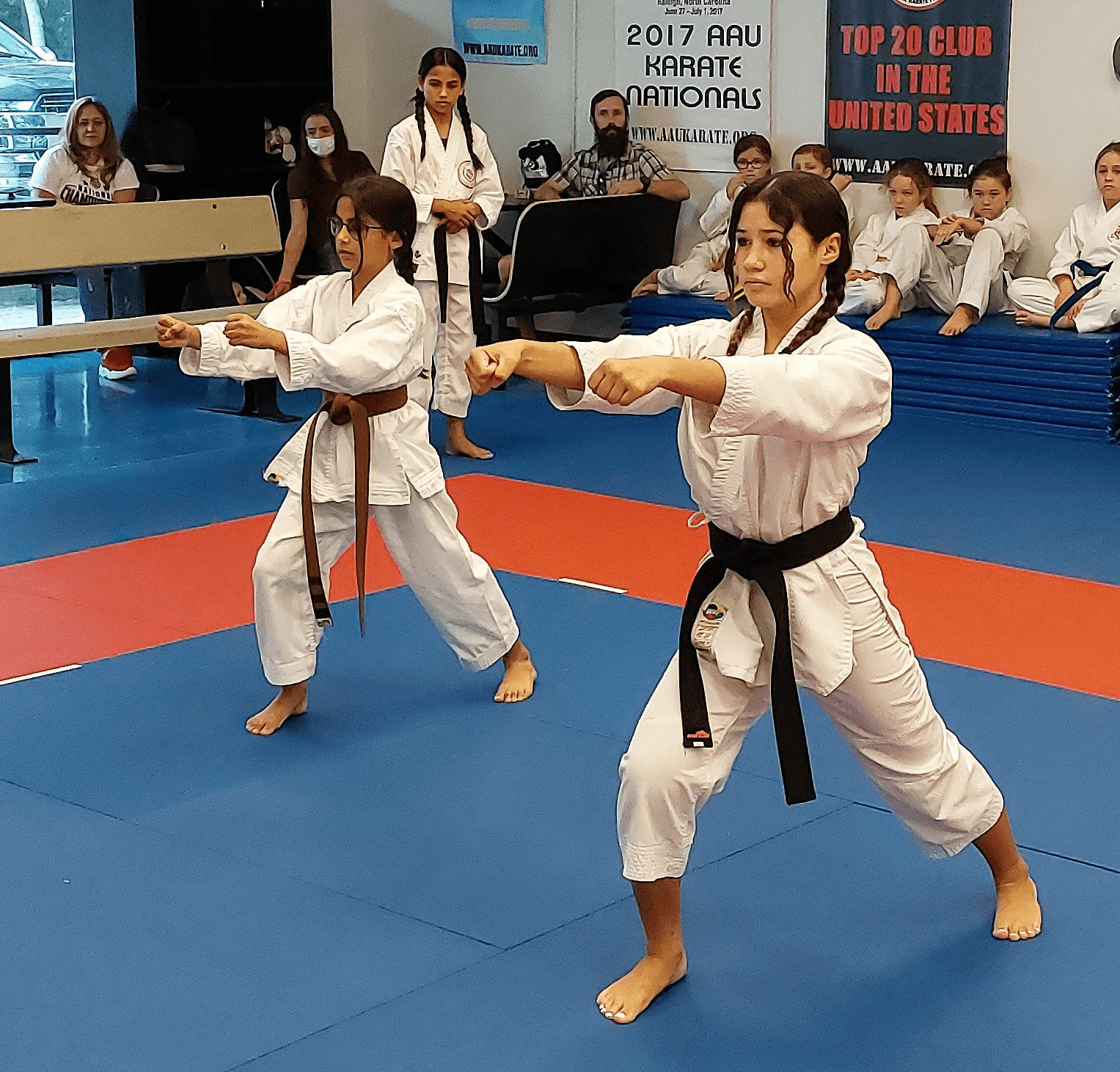
A child does not build confidence by being told they are confident. It happens by drilling a technique badly, then less badly, then well enough to demonstrate it at belt testing in front of the class. Discipline follows the same pattern, learned through standing in formation, waiting for a turn, and following an instruction the first time it is given, not through a lecture about discipline itself. Focus is treated the same way a teacher at Citrus Elementary or Glendale Elementary would treat it: built through repeated practice and correction, not assumed to already exist in a young child. This approach to child development shapes every class here. A Pre-K session and a youth class share almost nothing in structure, even working toward the same rank system, because the instructors treat a five year old and a ten year old as needing entirely different kinds of attention rather than a scaled-down version of the same lesson plan. Parents training through family martial arts frequently mention that the same patience and attention shows up later, at home, during homework or bedtime routines.
Why This Dojo, Given the Other Options Nearby
-
Beginners get a dedicated Pre-K class, not a scaled-down version of an older kids' program.
-
One instructor has taught every level since 1994, rather than a program split across a rotating group of assistants.
-
Rank is tested, not assumed, so a belt here means the technique behind it actually holds up.
-
Karate, jujitsu, weapons, and Arnis are taught under a single roof, avoiding the need to enroll in a second school later.
What Enrolling Actually Involves
-
Reach out first. A call, an email, or the contact form sets up a first class for a Pre-K student, an older child, or the whole family.
-
Try a beginner class. Pre-K karate, youth martial arts, and the family program can all be watched or joined once before committing to anything.
-
Get fitted and pick a schedule. A uniform gets sized, and class times get chosen around school pickup and after-school routines.
-
Start working toward the first belt. Progress follows a real curriculum, tracked class by class rather than handed out automatically.
Areas We Serve
Students from Vero Beach South train with families from Vero Beach, Indian River County, Sebastian, Indian River Shores, North Beach, South Beach, Osceola Park, Beachland, and West Vero Corridor. Our flexible weekday evening and Saturday martial arts classes make it easy for families across these nearby communities to train together year-round.